Jewelry Pliers
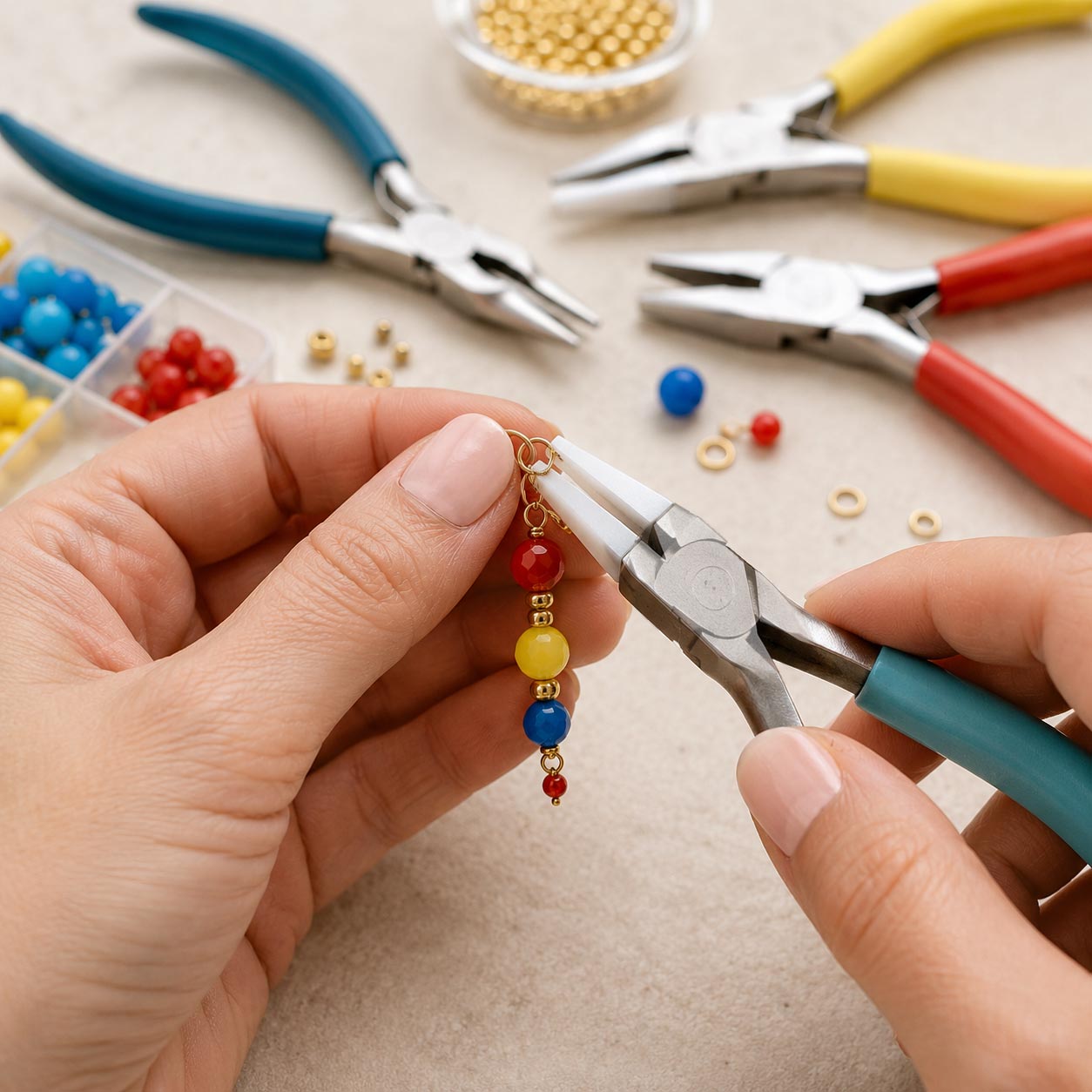
Jewelry pliers are among the most important tools used in jewelry making. They allow crafters to hold tiny components, shape wire, open and close jump rings, attach findings, make loops, bend head pins and eye pins, cut wire, and create clean, secure connections. Although many pliers look similar at first glance, each style is designed for a specific purpose.
Using the proper pliers can make jewelry projects easier and can also help prevent damage to beads, wire, chain, and findings. A beginner does not need every specialty tool right away, but understanding the most common types of jewelry pliers makes it much easier to choose the right tool for each task.
Common Types of Jewelry Pliers
| Tool | What It Looks Like | Common Uses |
|---|---|---|
| Round Nose Pliers | Tapered, rounded jaws | Making loops, eye pins, wrapped loops, coils, and curved wire shapes. |
| Chain Nose Pliers | Flat inside jaws with a tapered pointed tip | Opening jump rings, gripping small parts, bending wire, and reaching tight spaces. |
| Flat Nose Pliers | Wide, flat jaws | Holding, flattening, straightening, and making sharp bends in wire. |
| Nylon Jaw Pliers | Flat jaws with replaceable or permanent nylon pads | Straightening, shaping, and gripping delicate wire or jewelry components without scratching or marring the surface. |
| Bent Nose Pliers | Angled jaws | Reaching awkward angles, holding jump rings, and working in tight spaces. |
| Crimping Pliers | Small shaped notches in the jaws | Securing crimp beads and crimp tubes on beading wire. |
| Flush Cutters | Cutting jaws with one flatter side | Cutting wire cleanly with a flatter finished end. |
| Mini Jewelry Pliers | Smaller versions of standard jewelry pliers | Precision work, travel kits, beadwork, tight spaces, and projects involving very small components. |
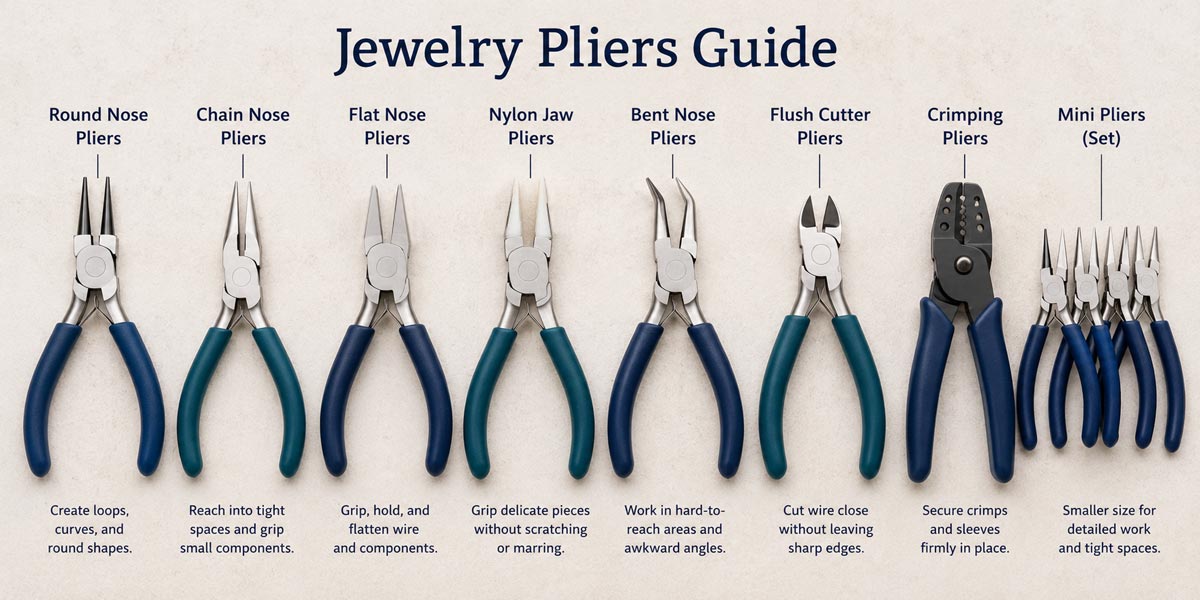
Round Nose Pliers
Round nose pliers have two tapered, cone-shaped jaws. They are used to make loops, curves, coils, and rounded wire shapes. The farther down the jaw you place the wire, the larger the loop will be. Working near the tip creates smaller loops.
Round nose pliers are especially useful for making eye pins, wrapped loops, bead dangles, earrings, charms, and decorative wirework. Because the jaws are rounded, they bend wire smoothly rather than creating sharp corners.
Chain Nose Pliers
Chain nose pliers are one of the most useful general-purpose jewelry tools. They have tapered jaws that are flat on the inside and usually smooth to avoid marking wire or findings. Their pointed shape allows them to reach into small spaces while still providing a firm grip.
They are commonly used to open and close jump rings, grip wire, bend small components, tuck wire ends, hold findings, and assist with many jewelry assembly tasks. Many jewelry makers keep two pairs of chain nose pliers so they can hold a jump ring with one pair while opening or closing it with the other.
Flat Nose and Bent Nose Pliers
Flat nose pliers have wider, flat jaws that provide a strong grip. They are helpful for holding pieces securely, straightening wire, making angular bends, and flattening small components. Because they grip over a larger surface area, they can be useful when more control is needed.
Bent nose pliers are similar to chain nose pliers, but the tips are angled. The bend allows your hand to stay out of the way while working close to the project. They are helpful for opening jump rings, holding tiny parts, and reaching areas that are awkward with straight pliers.
Nylon Jaw Pliers
Nylon jaw pliers, sometimes called soft jaw pliers, are similar in shape to flat nose pliers but have smooth nylon inserts covering the gripping surfaces. The softer jaws grip wire and delicate jewelry components without scratching, denting, or marring finished surfaces.
These pliers are commonly used to straighten craft wire, shape decorative wire, hold plated findings, grip polished metal components, and work with delicate jewelry pieces that could be damaged by ordinary steel jaws. They are especially useful when working with silver-plated, gold-plated, anodized, painted, or colored wire where scratches would be highly visible.
Because the nylon jaws cushion the material, they are not intended for heavy gripping or cutting. Over time the nylon inserts may become worn and, on many models, can be replaced when necessary.
Crimping Pliers
Crimping pliers are designed to close crimp beads and crimp tubes around beading wire. They usually have two shaped notches. One notch folds or compresses the crimp, and the other rounds it into a neater finished shape. When used correctly, crimping pliers create a more secure and professional-looking finish than simply flattening a crimp with ordinary pliers.
Crimping is commonly used when making strung necklaces, bracelets, anklets, and other jewelry using flexible beading wire. The crimp secures the clasp or finding at the end of the strand.
Wire Cutters and Flush Cutters
Wire cutters are used to cut head pins, eye pins, craft wire, beading wire, and other jewelry materials. Flush cutters are especially useful because one side of the cut is flatter and cleaner than a standard cut. This helps reduce sharp edges and gives jewelry a neater finish.
Not all cutters are designed for every type of wire. Fine jewelry cutters can be damaged by heavy, hardened, or memory wire. Memory wire should be cut with memory wire cutters, not ordinary jewelry flush cutters.
Mini Jewelry Pliers
Mini jewelry pliers are compact versions of many standard jewelry pliers, including chain nose, round nose, flat nose, bent nose, cutters, and crimping pliers. Their smaller size makes them especially useful when working with seed beads, delicate findings, fine wire, and other small jewelry components.
Because of their shorter handles and smaller jaws, mini pliers offer excellent visibility and control in tight spaces. They are popular with beginners because they fit comfortably in smaller hands, and experienced jewelry makers often keep a set in a travel or workshop kit for quick repairs and portable projects.
Although mini pliers perform many of the same tasks as their full-size counterparts, they generally provide less leverage and are not intended for bending heavy-gauge wire or cutting thick materials. For larger projects, full-size pliers are usually more comfortable and require less hand pressure.
Specialty Jewelry Pliers
As your jewelry making skills grow, you may discover specialty pliers designed to perform specific tasks more quickly, more accurately, or with less risk of damaging your work. While most beginners can complete many projects using just a few basic pliers, these specialty tools can make certain techniques easier and produce more consistent, professional results.
- Bail Making Pliers
- These pliers have graduated cylindrical jaws with several fixed diameters, making it easy to create consistent loops and bails for pendants. They are especially useful when making multiple identical components.
- Looping Pliers
- Designed to form loops in head pins and eye pins quickly and consistently. Some models trim the wire and create a loop in a single motion, making them popular with jewelry makers who produce large quantities of earrings or charms.
- Nylon Jaw Pliers
- Flat jaws covered with smooth nylon pads protect plated, painted, polished, and delicate wire from scratches and tool marks. They are also useful for straightening wire without damaging its finish.
- Parallel Jaw Pliers
- Unlike ordinary pliers, the jaws remain parallel as they close, providing even pressure across the entire gripping surface. They are useful for holding flat components securely, making precise bends, and reducing distortion.
- Ring Bending Pliers
- Designed to help form smooth curves and rings in wire and soft metal. They simplify creating uniform shapes that would be difficult to make consistently with standard pliers.
- Wire Twisting Pliers
- Used to twist two or more wires together into decorative patterns or secure wire connections. They are commonly used in wire wrapping and artistic jewelry designs.
- Hole Punch Pliers
- Used to punch small holes in soft metal blanks, leather, thin plastic, and similar materials when creating custom jewelry components.
- Split Ring Pliers
- Feature a small tooth that separates the coils of split rings, making them much easier to open when attaching charms, keys, or findings.
- Memory Wire Cutters
- Made specifically for cutting hardened memory wire. Ordinary jewelry cutters can be damaged if used on memory wire, so dedicated cutters are strongly recommended.
Most jewelry makers purchase specialty pliers only when a project or technique requires them. As you learn new skills, adding the appropriate specialty tool can often make a difficult task much easier while improving the appearance and consistency of your finished work.
Frequently Asked Questions
Do I need full-size or mini jewelry pliers?
No. Either size can perform many of the same tasks. Mini pliers provide excellent control for delicate work, small beads, and fine wire, while full-size pliers offer greater leverage and are generally more comfortable when working with heavier wire or making repetitive bends. Many jewelry makers eventually keep both sizes and choose the one best suited to the project.
Can I use household pliers for jewelry making?
You could but you probably don't want to. Household pliers are designed for heavier work and often have serrated jaws that can scratch, dent, or permanently mark delicate jewelry findings and wire. Jewelry pliers usually have smooth jaws designed specifically for precision work.
Why do my pliers leave marks on my wire?
Marks are usually caused by gripping the wire too tightly or by using pliers with textured or worn jaws. Smooth-jawed jewelry pliers or nylon jaw pliers help reduce tool marks when working with delicate wire and finished jewelry components.
Do I need every type of jewelry pliers?
No. Many beginners start with chain nose pliers, round nose pliers, and flush cutters. As your skills and projects expand, you can add specialty tools such as crimping pliers, bent nose pliers, or nylon jaw pliers.
Why do many jewelry makers own two pairs of chain nose pliers?
Using two pairs allows you to hold one side of a jump ring while twisting the other side open or closed. This helps maintain the ring's round shape and creates a tighter, more professional-looking connection.
Helpful Tips
- Choose smooth-jawed pliers for jewelry making to reduce marks on wire and findings.
- Use two pairs of pliers when opening and closing jump rings.
- Open jump rings by twisting the ends sideways, not by pulling them apart.
- Do not cut memory wire with regular jewelry cutters.
- Keep jewelry pliers separate from household tools so they stay clean and smooth.
- If pliers leave marks, use lighter pressure or consider nylon jaw pliers for delicate wire.
- Mini jewelry pliers are excellent for delicate work and small hands, while full-size pliers provide more leverage for heavier wire and larger components.
- Use nylon jaw pliers whenever working with plated, painted, or polished wire and findings to help prevent scratches and tool marks.
Did You Know?
Many beginners try to open jump rings by pulling the ends away from each other. This can distort the ring and make it difficult to close neatly. Jewelry makers usually open jump rings by twisting one end forward and the other backward, then twisting them back into alignment.